Kyoto & the Stories That Shape Us
This piece is part of an ongoing exploration of narrative power and climate proximity.
When I first heard David Bowie’s The Man Who Sold the World, I remember wondering who that man was. When I walked out of Kyoto by Good Chance Theatre at Lincoln Center Theater, I remember thinking it might be Don Pearlman.
Don Pearlman was, according to Wikipedia, “an American lawyer and oil industry lobbyist, primarily known for his opposition to the scientific consensus on climate change and his efforts to stall or prevent the adoption of the Kyoto Protocol.” In Kyoto, he is also our resilient, off puttingly reasonable, unreliable narrator. A man driven by a self-story that folds cleanly into one of the most familiar versions of the American ideal. “This is America, Shirl. We’ll figure it out,” he tells his wife.
It's a comforting line for many. One that’s helped people sleep through uncertainty for most of postmodernity.
Kyoto reenacts the geopolitical theater of 1989 to 1997, that Don was central to. Those early years of the Conference of the Parties that eventually produced the first legally binding agreement requiring developed nations to reduce greenhouse gas emissions. This was the moment the United Nations Framework Convention on Climate Change moved from voluntary pledges to mandatory targets. This acts less as a history lesson than an origin story we are still living inside.
“There are a lot of people who go to the theater to encounter human truths but would rather not be interrupted by the inconvenience of them,” said British theater critic Mickey Jo.
Kyoto insists on the interruption.
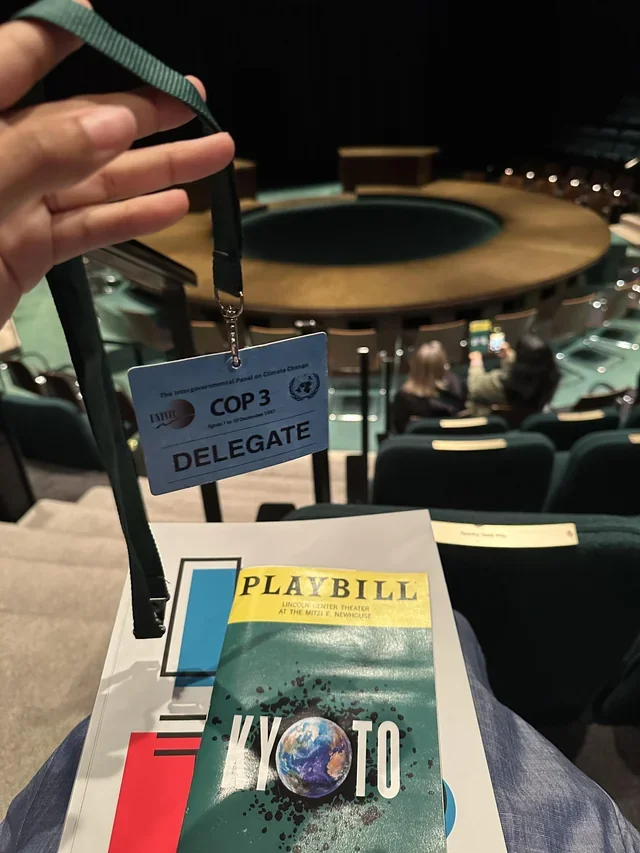
Before you reach your seat, a lanyard is placed around your neck. You’re assigned a country. The stage is a roundtable. Procedure rules the room. What should feel tedious becomes unavoidable. You’re not watching the process from a distance. You’re seated within it. The decisions feel closer than expected.
Across two acts, the play traces how climate action slowed, how disinformation softened urgency, and how doubt was often framed as caution. The characters are recognizable even when their names are not. The logic persists. The arguments feel familiar, as if you have heard them recently, even if they are being spoken by someone from decades ago.
Midway through the play, Don’s scheme is in full effect as a fault line becomes visible.
The delegate from the United States says, “We refuse to debate the foundations of American freedom.”The delegate from China replies, “Perhaps American freedom is ill suited to the challenges of the future.”The exchange lands with a strange familiarity
What Kyoto begins to reveal is how stories shape the speed and direction of belief, and how the same narrative tools that delayed climate action also hold the potential to bring people back toward shared ground.
The hinge of the play arrives quietly, through a moment of beauty.
Before COP 2, the delegation is brought into the Brazilian rainforest. The atmosphere in the theater shifts. Werner Herzog leads an immersive staging of A Midsummer Night’s Dream. Strategy loosens its grip. Attention gathers. People stop posturing and begin noticing where they are standing, and who they are standing with.
Don Pearlman senses the shift immediately.
“There are artists everywhere,” he says. “And this is the first moment on this climate roadshow that I feel in real danger. That I sense true agreement may be staring at me from behind the trunks of these great trees. This is becoming fashionable.”
What unsettles him is how close everything suddenly feels. Distance narrows and defenses soften. The beauty of the art does something argument cannot. It brings people into shared presence before they can organize themselves against it.
Feeling arrives first. Thought follows. Language comes later. Action tends to follow the stories people recognize themselves in; as John O’Donohue reminds us in Anam Cara, “How you see, and what you see, determine how you will be.”
I saw Kyoto in October, coming off New York Climate Week which was during the United Nations General Assembly. I went with one of my co-founders, Alyce Shu. That week left me energized by the intelligence and care of people doing real work, and worn down by the choreography of global politics. What lingered though wasn’t anger, but persistence. The sense that so many people still want to work for better lives for one another, even when the systems meant to deliver them stall or don’t work at all.
The play sharpened something I felt but hadn’t fully named. We understand how we got here, recognize the tools that were used to slow progress and we aren’t as far from knowing how to move forward as it sometimes can feel.
Art or story don’t solve climate change on their own. What it does offer is a way into the work that does not overwhelm. It can be a place to experience complexity without collapse. To sit with grief at a chosen distance. To leave with a clearer sense of how you might act honestly from where you stand.
Good Chance Theatre makes this tangible. At the end of the performance, every audience member receives access to an action guide designed to turn urgency into movement. Emotion is not treated as an endpoint, it’s treated as fuel. As they put it, “passion and positivity are our most reliable sources of renewable energy.”
In the waning hours of the COP 3, a delegate from Kiribati speaks with precise impatience. “We don’t have time for a history lesson. Instead of reliving the pain again and again, my generation is asking how we can use it? What is the solution?”
History, staged this way, feels activating. There is this alertness in the room. You process grief together. You’re reminded that this is still your world under discussion, and that much of the work remains unfinished. The invitation to act eases the anxiety that often accompanies integration of systemic problems, not by minimizing them, but by making movement feel possible.
Near the end of the play, Raúl A. Estrada Oyuela, one of the heroic architects of the Kyoto Protocol, offers a simple truth. “There is always something we share. You just have to find it.”
It might be the places we love. The rituals we protect. The futures we imagine for people we may never meet. Climate solutions can naturally find a way of weaving themselves through all of it when we let them.
The fossil fuel industry has long relied on a calm, confident story that claims it gives us everything we care about. Now more than ever, that story is showing its fractures. The mechanics of belief shaping have not changed but our collective awareness of them has.
Kyoto shows how culture sits upstream of action.
When people are brought close to what they love, shared ground becomes visible. Futures that once felt distant begin to feel near enough to move toward together.